Launching into the Unknown: Thane Hudelson and UofL's Space Force Future
May 12, 2026
By Michael Phillips
By the time Thane Hudelson walks across the stage to commission in 2027, he will have already made history as the University of Louisville’s first Space Force cadet ever to commission. For the rising senior Computer Science major in Speed School of Engineering, the path to that milestone has been shaped by a family nudge, an Air Force ROTC scholarship, and a growing sense of purpose that extends beyond himself.
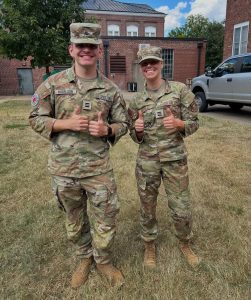
Hudelson’s road to computer science began with a simple recommendation from his aunt, a veteran of the Air Force. “My aunt was in the Air Force and my mom was talking to her when I was enrolling in high school about what classes I should do to be successful,” he recalled. “My high school offered some Java, like programming courses. And she recommended I take those.” He did, and he hasn’t looked back. “I really enjoyed learning about programming and actually going and doing it in those courses.”
When it came time to choose a college, his direction was clear. He had already applied to the Air Force Academy and Naval Academy after West Point reached out to him in high school, and he ultimately landed a full-tuition ROTC scholarship that featured a technical major requirement. “I was looking at CIS for a while through the School of Business, but I got a scholarship with Air Force ROTC,” he said. “It had a technical stipulation. It had to be a technical major and they didn’t consider CIS to be a technical major.” He weighed his options and landed on the Bachelor of Arts in Computer Science. “I figured BACS aligned more with what I was interested in and what my goals were.”
This summer, Hudelson heads to Colorado for a Space Force development program designed to immerse new cadets in the military’s newest branch. “So much of what they do is either classified, secret, or they just don’t talk about it because it’s so sensitive,” he explained. Attending required obtaining a top-secret security clearance. Once there, cadets will receive classified briefings on Space Force units, systems, and operations at a depth otherwise inaccessible.
The program also lays educational groundwork for post-commission training at Peterson Space Force Base. “Every Space Force second lieutenant will go to Peterson Space Force Base in Colorado Springs after they commission for training,” he said. “And they’ve recognized one of the hardest things to teach people there is orbital mechanics and gravity-based physics stuff – space physics basically. And we’ll get a baseline for those things there.”
The tone, he notes, is intentionally supportive rather than grueling: “They’re trying to build you up and put you in a better position to be successful during that training,” he shared, “and give you lessons you can take back to your detachment.”
Beyond the briefings, the program offers experiences that would be hard to find anywhere else. Hudelson is particularly excited about a zero-gravity parabolic flight, where cadets will “experience 0 gravity for several minutes” and conduct experiments. There’s also scuba training designed to simulate weightlessness, competitive model rocket building, and a joint field exercise with the Air Force Special Warfare program. “On the Space Force side, [we’ll be] giving space effects to these cadets that are doing special warfare things,” he said. “And it’s kind of like a joint domain operation simulation at the Air Force Academy. It’s really cool stuff.”
After Colorado, Hudelson will transition to Alabama to serve as cadet cadre for Air Force ROTC field training, a program that brings together roughly 2,000 cadets from across the country. His role will be grounded in his Computer Science background. “Day to day, my job is going to be in communications,” he said. “I’ll be working under an active duty communications officer. And essentially I’ll be like IT for the most part – helping people get on Microsoft Teams, get on the Wi-Fi networks, monitoring those things, setting up briefing rooms, making sure all the computers have what they need.”
He’ll also step into broader leadership roles as needed, staffing leadership courses, obstacle courses, and other training elements. Having gone through field training himself the previous year, he sees a clear opportunity to improve the experience for those who follow. “When I went through, there were a lot of hiccups, especially on the IT side, that I noticed. And going into that, I think I could make it better for the cadets this year than it was for me.”
He also views the assignment as a major networking opportunity. “I’ll have the ability to meet a lot of cadets from all around the country and active duty Air Force and Space Force members from all over the country,” he said, “and just get as much knowledge and information out of those people as I can and make some lasting connections.”
The weight of being first isn’t lost on Hudelson. “It’s pretty significant, honestly,” he said. “I think a big part of it for me is kind of building awareness and an image for what the Space Force does and kind of setting that baseline for future cadets.” Already, two more UofL cadets have been selected for the Space Force this year. “I’m hoping I can sort of teach and mentor them with the unique opportunities that I’m going to have this summer so that they’re better prepared than I was and they can better prepare the people that come after them. Like I just kind of want to establish that lineage within UofL to make people more aware of what the Space Force is, what they do, and help people get there if they desire that.”
For Speed School students curious about ROTC or the Space Force, Hudelson’s advice is straightforward: start with research, talk to cadets, and take the leap. “If they’re up for that commitment, then I’d say just give it a shot,” he said. “In your first two years, you don’t have any contractual obligation to stay.”
And for those drawn to the Space Force specifically, he points to the power of personal connections with active duty members, fellow cadets, and ROTC cadre who “know quite a lot about it.” “I think the main thing with getting people interested in the Space Force,” he said, “is spreading awareness and telling people what they do and what opportunities are available and really building that interest in that mission.”