Planting the Future: UofL Students Join a Decade-Long Mission in the Peruvian Andes
September 23, 2026
By Michael Phillips
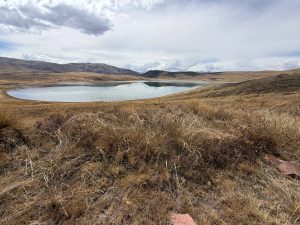
Lake Qoricocha
A mountain community in Peru is racing to reverse the process of desertification that has intensified over the past decade. This summer, the community received support from engineering, bioengineering, and geography students from the University of Louisville, who traded classrooms for a forest in progress surrounding Lake Qoricocha at 14,000 feet above sea level. On day one, fresh off a two-hour bus ride up windy mountain roads, they were handed loppers and hand saws and put to work pruning pine trees alongside the residents of Qenqo, the community they’d spend the next two weeks getting to know.
The forest is the site of Project Qoricocha, a long-term effort to fight desertification across mountainous land. The project is led by two organizations partnered with UofL: the Andean Alliance for Sustainable Development (AASD) and Campesino Forestal. Project Qoricocha’s governing ambitions are to plant a million trees over the next decade, capture water before it erodes, and build a model of land restoration that works with the local community rather than around it.
Each summer, students across engineering disciplines and focuses, joined this year for the first time by students from the GIS program, spend a semester meeting weekly before traveling to Peru for a two week International Service Learning Project. This year’s group included mechanical and bioengineering students working shoulder to shoulder with geography and environmental science majors, all contributing their unique skills to the same goal.

Qenqo community members and UofL students after pruning trees
“We’re out here in Peru doing drone capturing, drone imagery, for an aerial view, seeing all the trees that have been planted in a forest style, and using that to compare to past years and see the progress,” said Adaleigh Gaona, a third year mechanical engineering major. For her, the value goes beyond the data. “It’s good to interact with the local community. This has been really a great experience to see their day to day life, but also the organizations we’ve partnered with and the work they’re doing to create a more sustainable future.”
Julia Attevelt, co-founder of Campesino Forestal, explained why UofL’s involvement is so central to the project’s survival. “We receive funding from several organizations, from private donors,” she said, “and everybody needs to know what’s happening here. So we need to know how the trees grow, what is the survival rate of the trees, how soil is changing.” By mapping the land year over year with visiting students, the project can prove its impact to the people funding its future.
The project centrally aims to support the roughly 80 families and 400 people who call Qenqo home. Olivia Paulsen, a bioengineering major, saw that connection clearly while tagging newly planted trees. “This community is really relying on the future of this project to bring more money into the community and also to keep members from leaving,” she said, noting that many residents move to larger nearby cities like Calca in search of opportunity. The forest, in other words, can in the future serve as an economic anchor.
For L.C. Pearson, a post-baccalaureate student in geographic and environmental science, the appeal was the chance to work on a problem that can’t be solved in a single visit. “We are not just here as a one-and-done scenario,” Pearson said. “We are here to interact with the community, understand what they’re wanting and what their problems are, and giving them the tools to help out.” Days were spent tagging new trees, remeasuring old ones, and recording height and canopy data that future student groups will use to track progress.
That sense of continuity, of joining something bigger than a single trip, came up again and again. Rylan Becher, a rising sophomore bioengineering major, put it simply: “They have these plans of just making this area gorgeous, and it’s amazing to be able to help them and put our technology toward their goals.” Living with host families in Calca added another layer entirely. Becher’s homestay mother, Beatriz, “embraced us in so many different ways,” she said, describing shared meals and a homestay brother and sister who welcomed the students like family. Pearson had a similar experience with host Yoni, calling her “wonderful” and crediting her with opening up daily life in the community to the students staying there.
By the time the two weeks ended, the loppers and hand saws from that first exhausting day had given way to drone flights, tree tags, and long conversations with host families in Calca. The work will continue long after this group has gone home, carried forward by the next class of students who sign up not knowing quite what 14,000 feet feels like. Next summer, another group will climb off that same bus, pick up the same tools, and contribute to supporting Project Qoricocha.